-
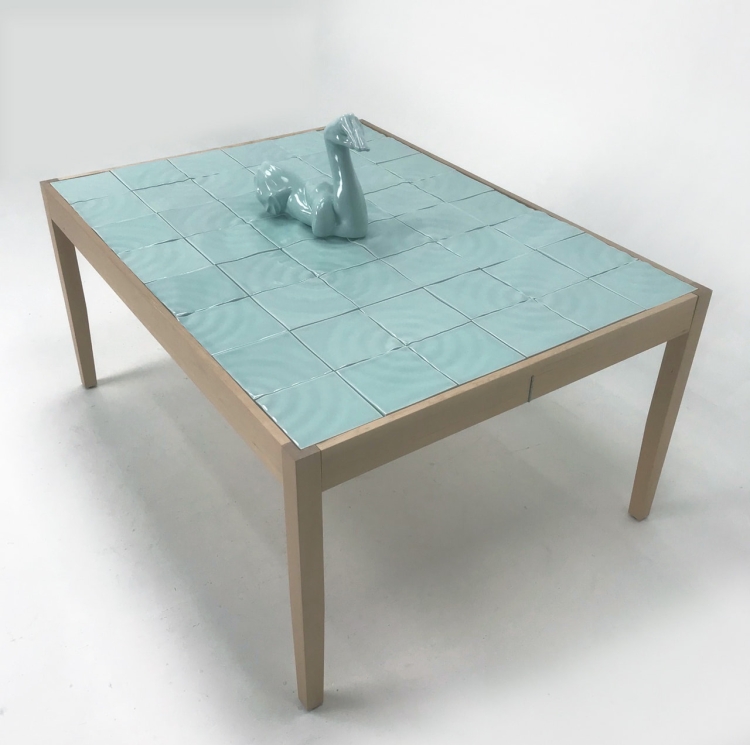
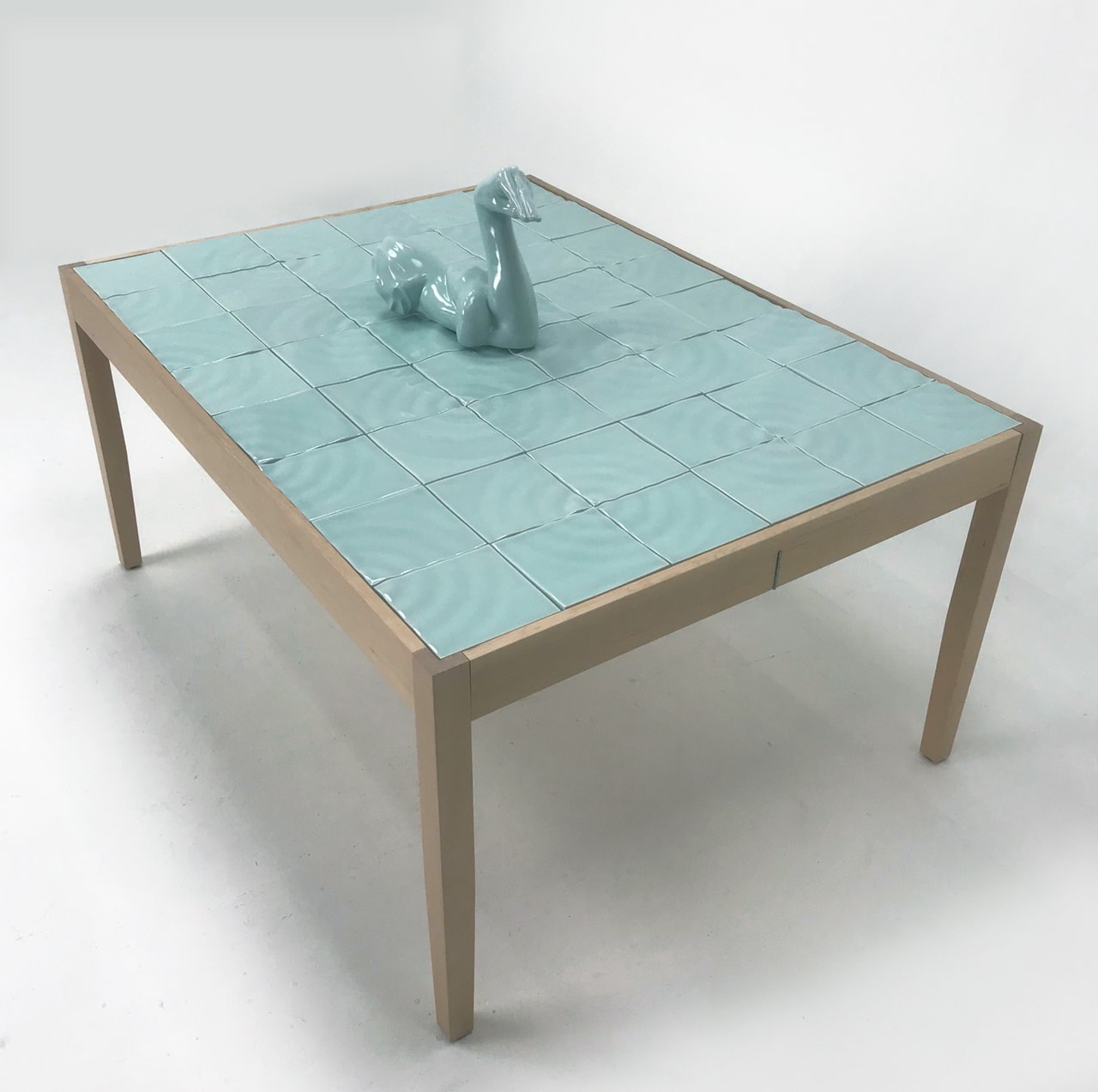
《Celadon・Lake 翠い湖》100×143.5×109 cm / Celadon Ceramic, Wood / 2024
Hideki Kimura, a leading contemporary printmaker and a painter who has been active in Japan and overseas since the 1970s, will present his first solo exhibition in four years at imura art gallery.
Since making a spectacular debut as a print artist, Kimura has produced a stream of works fusing paintings and prints, using mainly the silkscreen method and various surfaces such as paper, glass, and canvas. In the 1980s he created the ‘Water Bird Series’ expressing images of water birds through silkscreen printing. Now, some 40 years later, the artist has returned to this series with a new choice of medium: ceramics.
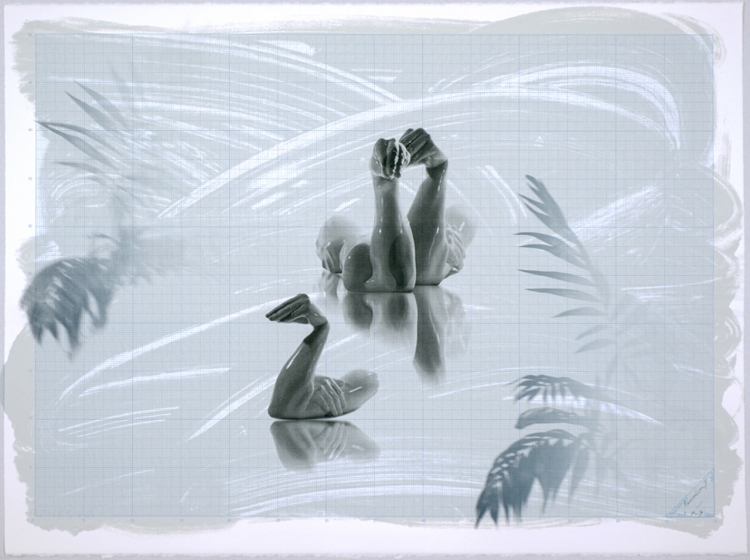
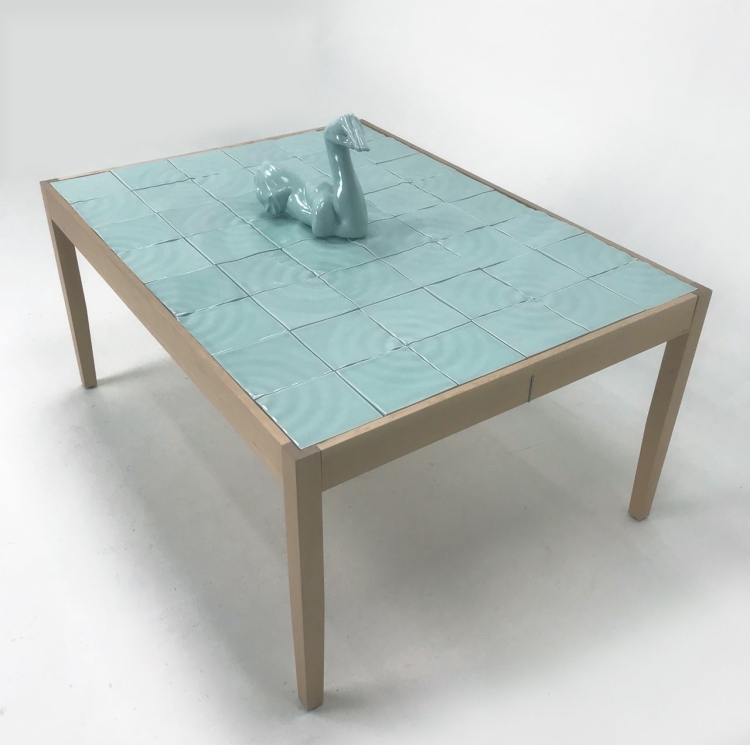
The exhibition will feature nine new creations, including two three-dimensional mixed media works that surround a celadon water bird with ripple-pattern tiles—‘Celadon・Lake 翠い湖’ and ‘Celadon・A Water Bird on the Pool’—and silkscreen prints using photographic images of celadon water birds. The ‘Celadon Water Birds and Ripple-pattern Tiles’ pieces, the central elements of this showing, were crafted through complex process in which Kimura created plastic water birds and rippled tiles using a 3D software and printer, manually shaped them, made plaster molds of them, and then made clay castings that he dried, bisque fired, and glaze fired. Be sure to savor these new works that embody Kimura’s affection for the Awata ware ceramics business that used to be run by his family.
Artist Statement
<On the Theme ‘Water Birds’>
It started with a casual observation: the way my arms were positioned casually looked like a water bird. I believe it was in the early 1980s when I first noticed this. Subsequently, by having friends pose intentionally to resemble water birds and collecting numerous images, I began to consider the possibilities of creating something interesting with these observations.
From 1983 to 1986, I created about 30 pieces using this image of water birds, collectively referred to as the ‘Water Bird Series.’
The double imagery of arms and water birds can be interpreted as an image of ambiguity, but also as an analogy of indecision, vagueness, and indeterminacy. The core of this work revolves around this elusive quality, potentially leading to feelings of incompleteness, unfinishedness, confusion, and frustration, which I found surprisingly interesting.
Initially, the creation of the ‘Water Bird Series’ was predicated on the use of photo stencil silkscreen techniques. Through the ‘Pencil’ (*1) and ‘Blinder’ (*2) series attempted in the 1970s, I concluded that images printed using photo stencil silkscreen possess an ambiguous existence. Enlarged to life-size, the ‘pencil’ image exists while fluctuating on the boundary between fiction and reality, neither material nor image, or perhaps both, celebrating its ambiguity. I called this unique presence ‘membranousness’ and have since been directing my creative efforts towards cultivating it.
The foundational concept behind the ‘Water Bird Series’ centers on crafting a dual sense of ambiguity, blending the equivocal nature of water birds with the ‘membranousness’ quality of silk, effectively doubling the ambiguity. This approach can be symbolically represented as ‘ambiguity multiplied by ambiguity equals X’. The question arises: what does X represent? Can this question even be answered? And if it can, might it not give rise to a wholly unprecedented scene or vision? These indistinct expectations became my motivation.
On the other hand, ambiguity equates to vagueness and indeterminacy. Could the square of ambiguity only lead to greater ambiguity and unimaginable confusion? It's a conceivable expectation.
Creating artwork is similar to architecture. There's a foundation, upon which a framework is placed, then walls are added, and finally, the interior and exterior are completed. There is a demand at each stage of the process for robust stability. However, what if ambiguity, or a lack of reliability, was inserted into one part of the creation process? At the very least, there would be a constant fear of collapse and disintegration.
The methodology of ‘ambiguity squared’ might only be fine for the construction of a castle in the sand or, at best,setting up a temporary scaffold. A valid concern, indeed. Yet, I found this prospect intriguing.
If the to-be-completed construction or artwork can only guarantee unexpected results, then a freedom is born within the production process. At the very least, freedom from restrictions on materials and scale can be expected, and the creation site becomes a great experimental field. My intention amidst this chaos was a transversal development of the form of the work. Not stopping at the traditional form of printmaking but also transitioning to painting or canvases as supports and developing into three dimensional images or installations.
The ‘Water Bird Series’ may be described as a cross-media examination of various aspects of thought in the midst of uncertainty, with ambiguous images and indeterminacy at its core. It started around 1983 but came to a temporary halt around 1986. After about a 40 year hiatus, I changed the medium to celadon ceramics, leading to this solo exhibition.
On a personal note, my grandfather was involved in the production of Awata ware ceramics in Kyoto during the Meiji and Taisho periods. His son, my father, worked in the trade of Awata ware and Kiyomizu ware. In essence, I am the son of a pottery family. Although I spent my life mostly disconnected from ceramics after entering art school, I've found myself reflecting more on my father, who I lost at the age of six, and have felt a growing desire to create something befitting the son of a pottery family. One reason for using the words ‘Reunion’ and ‘Bond’ in the title of the series was to imply the meaning of family bonds. Another was my curiosity about whether it's possible to find a connection between my work from 1986 and 2024.
Celadon ceramics are beautiful in their own right, unquestionably so. I warmly invite you to view the exhibition and appreciate your interest in experiencing it.
Hideki KIMURA
EXHIBITED ARTWORKS
EXHIBITION
ARTISTS

VENUE

- URL
- https://www.imuraart.com/
- 住所
- 京都市左京区丸太町通川端東入東丸太町31
- Tel
- 075 761 7372
- 開館時間
- 12:00 — 18:00
- 休館日
- Sun・Mon・Holiday
- 入館料
- 無料