A Small Love Story: The World of Mameban Shunga
Feb 14 — Mar 15, 2026
Opening Hours:11:00–19:00 (last admission 18:30)
Late-Night Opening:Every Friday & Saturday, 11:00–21:00 (last admission 20:30)
Venues (Two Locations):
〇Shinjuku Kabukicho Noh Stage (Reception and check-in will take place at this venue)
2F, Lions Plaza Shinjuku 2-9-18 Kabukicho, Shinjuku-ku, Tokyo
Access:
3-minute walk from Shinjuku-sanchome Station (Exit E1)
(Tokyo Metro Marunouchi Line / Fukutoshin Line / Toei Shinjuku Line)
8-minute walk from Seibu-Shinjuku Station (North Exit)
〇BOND
Kabukicho Social Building 9F
1-2-15 Kabukicho, Shinjuku-ku, Tokyo
Access:
7-minute walk from Higashi-Shinjuku Station (Toei Oedo Line)
9-minute walk from Shinjuku-sanchome Station (Tokyo Metro Fukutoshin Line)
12-minute walk from JR Shinjuku Station (Yamanote Line)
World Premiere!
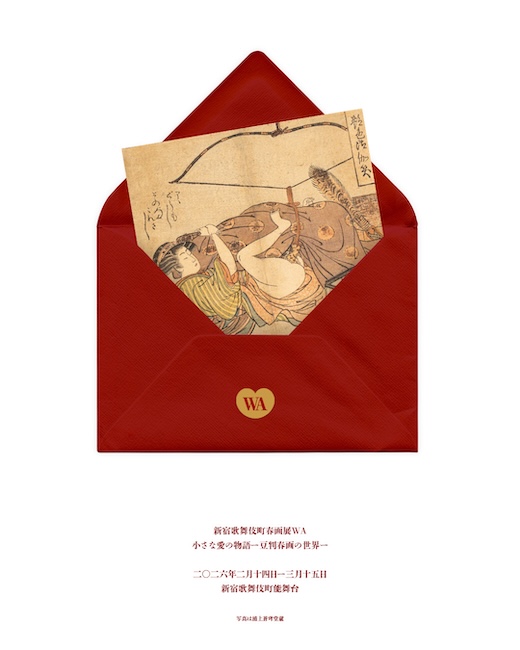
An exhibition composed exclusively of palm-sized shunga, Mameban Shunga, “bean-sized” shunga works, approximately 300 works unveiled at once in Kabukicho
“A Small Love Story: The World of Mameban Shunga.”
will be held from February 14 (Sat) to March 15 (Sun), 2026, in Kabukicho, Shinjuku, Tokyo. The exhibition is organized by Smappa!Group.
This exhibition marks the world’s first presentation devoted exclusively to Mameban shunga, “bean-sized” shunga, palm-sized woodblock prints exploring intimacy and desire, featuring approximately 300 works from the collection of Mitsuru Uragami, representative of Uragami Sōkyūdō.
Only Uragami’s unparalleled collection, exceptional in both quality and scale, makes such an unprecedented Mameban-shunga-only exhibition possible.
Among the exhibited works, approximately 80 pieces were previously shown in Japan’s first-ever Shunga Exhibition held in 2015 at the Eisei Bunko Museum in Tokyo and are being displayed again for the first time in 11 years.
The exhibition takes place across two venues: the Shinjuku Kabukicho Noh Stage and BOND, a former host club currently closed.
Smappa!Group has long been engaged in initiatives to “create Japanese culture from Kabukicho,” using venues such as Noh stages and host clubs as bases for activities including Japanese dance, tanka poetry, and reading salons.
Within this context, the exhibition brings together the world of Mameban shunga and the distinctive character of Kabukicho. Under the art direction of Yasutaka Hayashi (Chim↑Pom from Smappa!Group), it offers a new mode of viewing, where Edo-period intimacy and contemporary urban culture intersect to create a fresh and immersive experience.
Small in Size, Astonishing in Detail:
The World of Mameban Shunga
Small enough to fit in the palm of your hand, charming in scale, Mameban shunga, “bean-sized” shunga works are miniature, multicolored woodblock prints (nishiki-e) depicting intimacy, desire, and human closeness themes, printed at roughly palm size.
Their standard dimensions are approximately 9 cm high by 12.3 cm wide. Many were originally sold as sets of twelve or eight prints, tucked into small wrappers and offered at affordable prices. Thanks to their delightful size and accessibility, they were enjoyed by a remarkably wide audience, from common townspeople to feudal lords.
Yet their smallness and cuteness should never be underestimated.
The distinctive humor of shunga, often referred to as “laughing pictures”, is fully present. These works playfully allude to classics such as Kanadehon Chūshingura, Tsurezuregusa (Essays in Idleness), and Hyakunin Isshu (One Hundred Poets, One Poem Each), while also weaving in references to games like go, the tea ceremony, and even appearances by the Shichifukujin (Seven Lucky Gods).
Within these palm-sized images, the artists’ ingenuity and the exceptional skills of carving and printing are astonishingly concentrated. There is no compromise, no shortcut. In their irresistible smallness, inviting viewers to lean in closer, the pride and dedication of Edo-period craftsmen are packed tightly and vividly.
Passed from Hand to Hand
During the Edo period, alongside the official shogunate calendar, there existed a custom of privately issued pictorial calendars known as daishō, which were exchanged like New Year’s greeting cards. Inspired by this playful tradition, illustrated calendars infused with shunga imagery emerged, eventually giving rise to Mameban shunga.
It is said that at the New Year, feudal lords exchanged Mameban shunga inscribed with the year’s calendar. Some works in this exhibition still contain such calendrical devices. We invite you to look closely and discover them for yourself.
This culture of gifting Mameban shunga continued into the modern era. During the Sino-Japanese and Russo-Japanese Wars, soldiers departing for the front were sometimes sent off with these small prints. A single, modest image, passed from person to person, accompanied lives across many different moments, quietly offering comfort and connection.
Looking Straight at the Image, Free from Preconceptions
Many Mameban shunga remain shrouded in mystery. In numerous cases, we do not know who created them or where they were printed. Even today, much about them remains unresolved.
Yet perhaps it is precisely because of this anonymity that we are able to face the images directly, free from names, reputations, or established evaluations, and engage with the works themselves, honestly and openly.
Now then, step into the world of Mameban shunga, unfolding in the palm of your hand.
Do not underestimate them because they are small.
Through these miniature prints, enjoy a moment of close intimacy.
Note:
Japan’s first-ever Shunga Exhibition was held in 2015 at the Eisei Bunko Museum in Mejirodai, Tokyo.
Mr. Mitsuru Uragami played a key role as a member of the organizing committee for the exhibition’s Japan presentation, contributing significantly to its realization. The exhibition attracted approximately 210,000 visitors during its run and generated widespread public attention.
VENUE
- URL
- https://nohstage.com/
- 住所
- 〒160-0021 Lions Plaza Shinjuku 2F, Kabuki-cho 2-9-18, Shinjuku City, Tokyo, Japan 160-0021
- Tel
- +81 3 6380 3663
- 入館料
- 0円
- 備考
- Opening hours, closed days, and admission fees vary by event.
NOTES
Tickets
Admission Fees
General: ¥1,100
Students: ¥700 (On-site payment only. Valid student ID required.)
Visitors holding a valid disability certificate and one accompanying person are admitted free of charge.
This exhibition uses date-specific ticketing. Purchase your ticket for a selected date online. No time slot is required; enter at any time during opening hours on your chosen date.
If capacity allows, same-day entry without a reservation will be accepted. Please note that visitors with reservations will be given priority.
Re-entry is permitted on the same day.
Admission is restricted to visitors aged 18 and over.
Age verification is required at the time of ticket purchase. Visitors may also be asked to present valid identification (My Number Card, driver’s license, health insurance card, etc.) upon entry.
ORGANIZERS
-
Smappa!Group